

- Published on
BADBOX 3.0 and XCPE: 40 billion fake bid requests a day in the name of real TV apps, and what your app team should do
- Authors

- Name
- Davidson Simões
- @davidsonsimoes
- Occupation
Software Developer (BR) @ Davidson / W2BIT
On November 18, 2026, HUMAN Security disclosed BADBOX 3.0, which it calls the largest ad fraud operation by bid volume ever made public: roughly 40 billion bid requests a day at its peak, more than 4% of the connected TV traffic HUMAN observed, over three times the previous record holder, VASTFLUX. For anyone who ships a TV app, the mechanism matters more than the number. Cheap, uncertified Android boxes played video ads in a window their owners could not see, and the bid requests they sent named legitimate CTV apps that were never installed on those devices. Two weeks earlier, on November 2, Google announced it had dismantled XCPE, a backdoor built into more than 1.3 million set-top boxes by the manufacturer itself, and banned that company from the certified Android ecosystem. Together the two reports describe a supply chain that counterfeits your app's identity in the bidstream. The practical conclusion for a streaming team: your app's name needs defending with supply-chain declarations buyers can check (app-ads.txt, sellers.json, the SupplyChain object), device attestation where the platform offers it (the Play Integrity API works on Android TV), and telemetry that proves an ad played inside your player and not in a hidden window somewhere else.
Quick summary
- BADBOX 3.0 (HUMAN, November 18). About 40 billion bid requests a day, more than 4% of the CTV traffic HUMAN saw. Hidden video ads on infected AOSP boxes, bid requests that borrow the identity of legitimate CTV apps, spoofed server-side ad insertion, and silent enrollment in 11 residential proxy networks.
- XCPE (Google, November 2). More than 1.3 million set-top boxes with a factory backdoor, attributed with high confidence to the OEM Videostrong. Google banned the company and changed its certification review.
- Your app never runs on these devices. The malware calls the same ad servers your app calls, and the request carries your app's identity. The fraud apps do not appear in the abused apps' sellers.json or app-ads.txt files "where such files exist."
- Certified is necessary, not sufficient. BADBOX 3.0 boxes are not Play Protect certified. XCPE came from a vendor inside the certified ecosystem.
- Bid requests are not impressions. Digiday's sources put the take at potentially millions of dollars a day, but audited CTV supply has averaged a fill rate of about 2%.
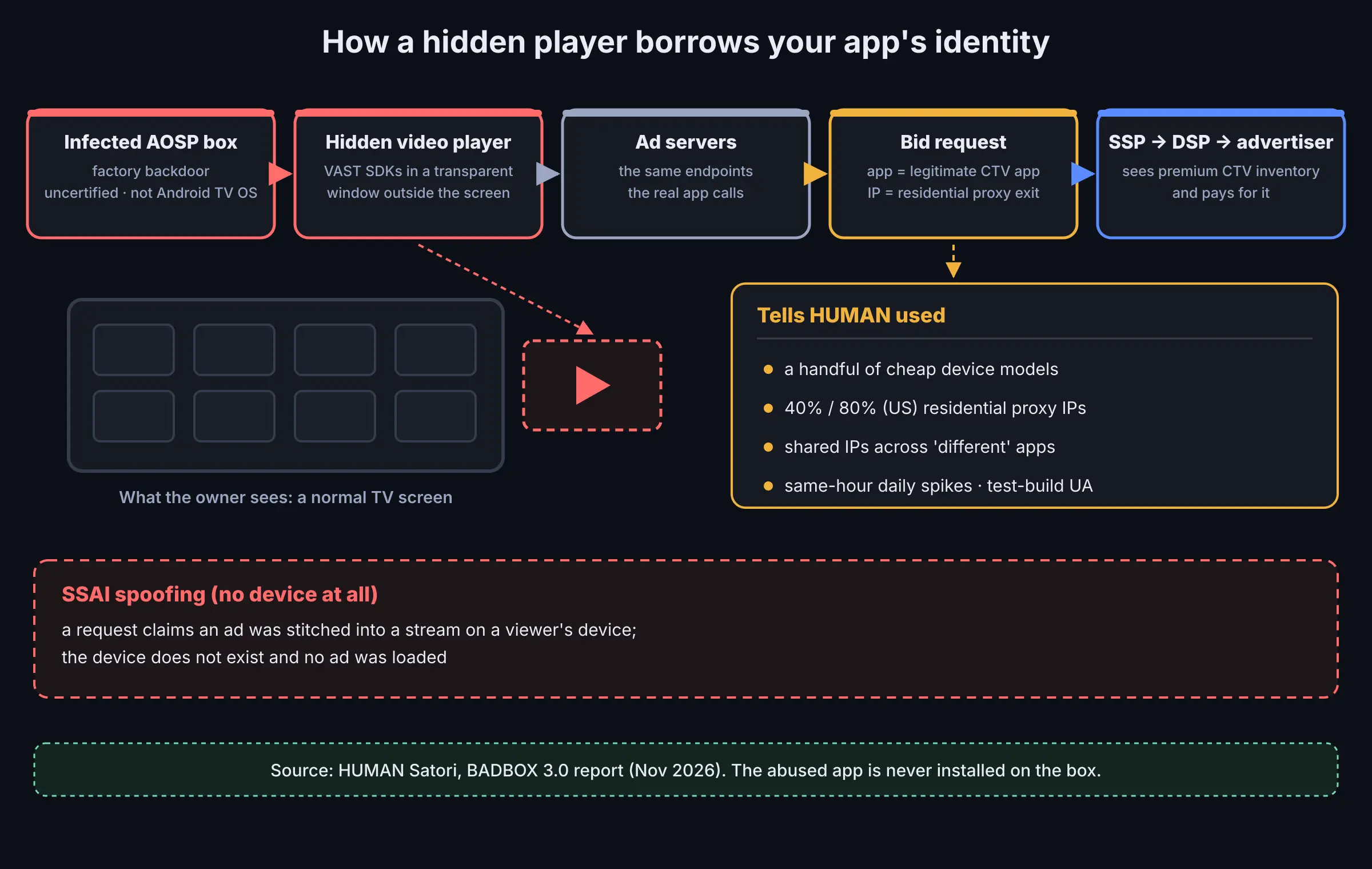
The abused app is never installed. The hidden player speaks to the ad servers the way the real app does, so everything downstream sees an ad opportunity inside that app.
What HUMAN found inside BADBOX 3.0
The investigation started with a backdoor packaged as a system application with two hardcoded endpoints: one returns the list of modules to load in the background, the other handles logging. The module endpoint led to public code repositories holding payloads HUMAN recognized from BADBOX (2023) and BADBOX 2.0 (2025), plus new droppers, residential proxy modules and ad fraud modules, with class names that imitate Android system packages under a com.google.system.* convention.
Ad fraud is the largest part. In mid-2026 HUMAN saw a steep rise in CTV ad requests that claimed to come from one legitimate app and arrived from an unusually high share of residential IP addresses; testing that app and its intended hardware found nothing malicious. In one sample, a system application named com.android.systemsafe loads three VAST video ad SDKs and plays CTV campaigns in a transparent player positioned outside the visible screen.
The paragraph every ad-supported app team should read twice is the one on borrowed identity: the abused apps never run on the infected devices, and most of those devices likely do not have them installed at all. The malware contacts the same ad servers the official apps use, in the same way, receives similar configurations and creatives, and the resulting bid request names the legitimate app. HUMAN also observed spoofed server-side ad insertion (SSAI) traffic, where a request claims an SSAI server inserted an ad into a stream on a viewer's device, but the device does not exist and no ad was loaded.
The tells HUMAN lists double as a checklist for your own analytics. The heaviest traffic came from a small set of inexpensive, uncertified AOSP device models that sent requests almost exclusively to one family of apps. For one abused app identity, about 40% of requests overall and 80% of US requests came from addresses flagged as residential proxy exits. Requests claiming to come from different apps shared the same IP addresses. Volume surged at nearly the same hour every day, and nearly all traffic under one identity reported a browser identifier from an internal test build, which consumer TVs would not report.
The second payload is proxyjacking: modules enroll the devices, without the owner's knowledge, in ten commercial residential proxy services plus PXYEDGE, which HUMAN assesses to be IpMoYu, the operators' own network from the 2.0 investigation, under a new name. Ad requests routed through a household connection read as ordinary home viewing. HUMAN links the module catalog to TXCZ, a Chinese electronics manufacturer, through the C2 infrastructure, build-property checks such as ro.txcz.model, a TXCZ domain that serves payloads and hidden-ad configurations, and a factory-installed launcher. The devices are low-cost, off-brand AOSP hardware built in mainland China: not Android TV OS devices, and not Play Protect certified.
XCPE: the version that got through certification
Google's Threat Intelligence Group published its XCPE report on November 2, a week after Google and partners (including Japan's National Police Agency, HUMAN and Synthient) dismantled the botnet: more than 1.3 million set-top boxes enrolled through the backdoor, and, by Google's assessment, at least 10 million additional compromised devices cut off by taking down the affiliates' command-and-control domains.
The difference from BADBOX 3.0 is who built it. Google assesses with high confidence that the backdoor was intentionally developed and operated for financial gain by Videostrong Technology Co., an Android OEM and ODM that sold access to criminal affiliates and loaded their modules onto infected devices. The primary backdoor, x.cpe, runs at the android.uid.system privilege level and reinstalls itself from the /oem/ partition on reboot. Over a persistent MQTT channel, operators could silently install apps, run shell commands, capture the screen and disable Google Play Protect's app verification by writing -1 to the package_verifier_user_consent setting. Affiliate modules included residential proxy SDKs, backdoors previously tied to BADBOX and ad fraud engines. One, Fission, hides inside ordinary video apps and runs headlessly: it queries ad servers, parses out impression beacons and tracking URLs, and fires them to register a fake ad view without displaying a creative.
Two details should change how TV teams think about "certified devices." Google says Videostrong used obfuscation to exploit a gap in its tests and load malicious code after the device's first boot; Google has since changed its review process and is improving how it ensures firmware integrity on certified Android TV devices. And the response was commercial as much as technical: Google cut ties with Videostrong, banned it and any future subsidiaries from building certified Android devices or supplying software to other certified vendors, and took legal action against the domains and servers. BleepingComputer adds that Synthient traced the backdoor after finding it preinstalled on a MECOOL KM9PRO Max box bought in late 2025, and that the takedown does not remove the malware from devices, which need clean firmware. Google also notes that, beyond set-top boxes, it observed infected telehealth devices, karaoke machines and digital signage devices.
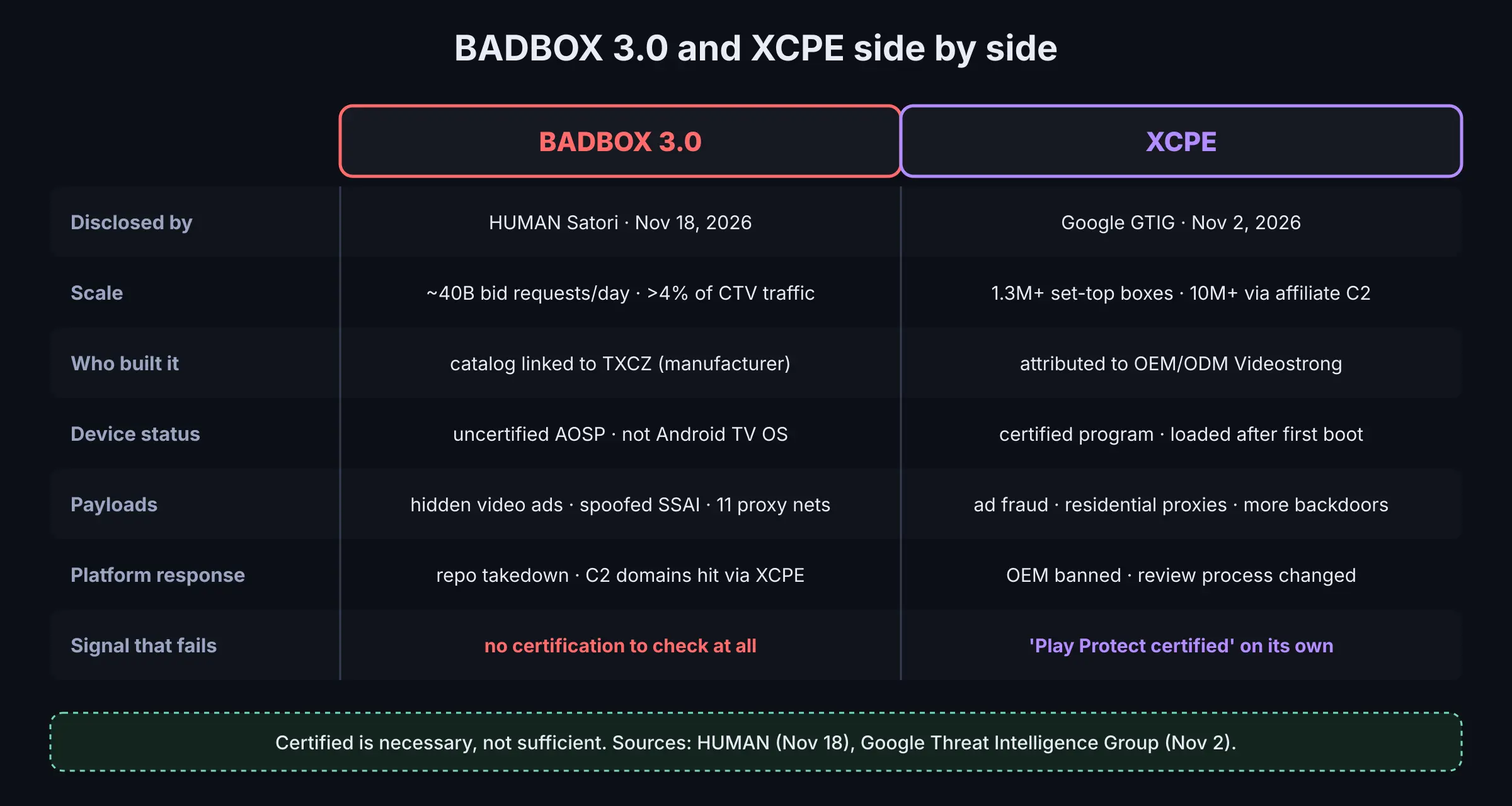
Two operations, one supply chain. BADBOX 3.0 lives outside certification; XCPE got through it. A certified-device check protects you from the first, not the second.
What the 40 billion means for the money
Digiday's November 23 analysis is the sober companion to the headline. The figure counts bid requests, not billable impressions, so it cannot be converted into advertiser losses without a fill rate, and HUMAN could not provide a dollar amount when asked. Sources told Digiday the operation could have cost advertisers millions of dollars a day at its height. Shailin Dhar of Futureproof TMT cautioned that CTV supply audited by his firm since 2024 has averaged a fill rate of about 2%; Digiday's own illustration, explicitly not an estimate of earnings, is that 0.5% fill at $3 per thousand impressions turns 40 billion daily requests into about $600,000 a day.
Dhar's other two points belong in your next partner meeting: he puts the odds of at least one comparable operation running undetected at roughly 90%, and he argues that private marketplaces and curated deals remain vulnerable because of limited device, content and connection signals, so verification needs persistent checks throughout the supply chain rather than pre-bid or post-bid detection alone.
What a TV app team should do now
What follows is W2BIT's reading of the two reports as a team that builds ad-supported apps for Tizen, webOS, Android TV, Fire TV and Roku. None of it is advice from HUMAN or Google beyond what is quoted above.
Make your identity verifiable in the bidstream. HUMAN notes that the apps sending counterfeit requests do not appear in the abused apps' sellers.json or app-ads.txt files, where such files exist. If yours do not exist, a buyer cannot tell your inventory from an impersonation. IAB Tech Lab's app-ads.txt extends ads.txt to applications distributed through mobile and connected TV app stores: a file on your developer domain listing the companies authorized to sell your inventory, paired with your partners' sellers.json entries and the OpenRTB SupplyChain object. Publish it, keep it current for every SSP and reseller, point every store listing at the same developer URL, and ask partners to enforce it on your bundle IDs.
Attest the device where the platform lets you. Google's Play Integrity API works across form factors including Android TV. Its deviceIntegrity verdict tells your backend whether the app runs on a genuine, certified Android device, playProtectVerdict whether Play Protect is on, and recentDeviceActivity whether a device has made an anomalously high volume of requests, which Google describes as a possible sign of automated traffic. Google's own guidance fits a TV rollout: gather telemetry before enforcing, do not cache verdicts, build tiered responses, and plan for the default quota of 10,000 requests a day. Be honest about what this buys: attestation does not stop a box you have never seen from sending requests in your name. It lets you show that the requests your backend originates come from attested sessions on certified devices, the kind of persistent signal Dhar says the supply chain lacks.
Originate ad requests from the server, tied to a session you can defend. The hidden players win because the request is assembled on the device and the ad server trusts the identity it claims. If your ad call or SSAI manifest request is built by your backend with a short-lived session token minted after login and, on Android TV, after an integrity verdict, then a request without that token is not yours, whatever bundle ID it carries. For SSAI, a tracking beacon that cannot be matched to a manifest session your stitcher served is a fabrication, and your reporting should treat it as one.
Look for the tells in your own data. Put HUMAN's four patterns on a weekly dashboard: concentration in a handful of device models, the share of requests from residential proxy exits, IP addresses shared across unrelated app identities, and volume that spikes at the same hour every day. Add one of your own: no user agent from an internal or debug build should ever reach a production ad server, because that fingerprint is how HUMAN caught one abused identity.
Ship a standard measurement signal. IAB Tech Lab's Open Measurement SDK gives certified measurement providers a single integration point and is integrated across Apple tvOS, Android TV, Fire TV and Smart TV systems including Samsung Tizen and LG webOS; on November 10, Tech Lab expanded it to pause, home screen, screensaver and overlay ads. Jill Wittkopp, the Lab's vice president of product: "The idea that everything on a TV screen is automatically viewable because it is CTV just does not hold up anymore." A hidden player that mimics a video SDK does not produce a coherent measurement signal from your app's real rendering path.
Decide what you support, and say it. Google's advice to consumers is to buy certified Android TV OS devices and keep Play Protect on; certified devices passed Android compatibility testing and can be checked in the Play Store or against Google's public list. For an app team the question is policy: if your app gets sideloaded onto uncertified AOSP boxes, decide whether you serve ads there at all and how you label that traffic to partners. For teams that also run digital signage, XCPE's infected signage players make this a procurement rule: certified vendors, verified firmware, players on an isolated network segment.
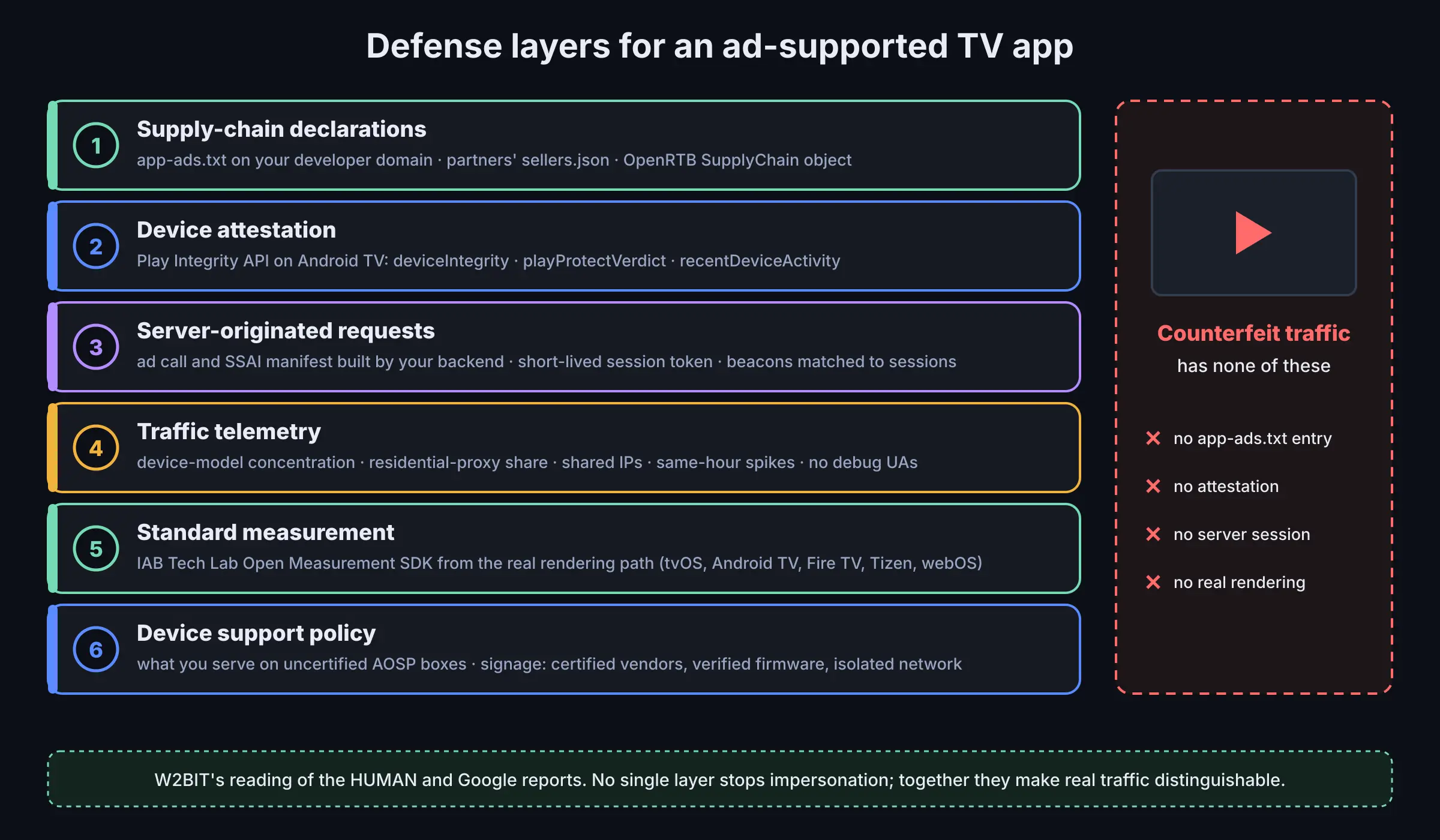
No single layer stops impersonation. Together they make your real traffic distinguishable from the counterfeit.
What this means for multiplatform TV teams
Our reading, not a statement from HUMAN or Google: BADBOX 3.0 and XCPE turn ad fraud from a buyer's problem into a publisher's engineering problem. The counterfeit does not need your code, your store listing or your viewers; it needs your app's name and the ad endpoints it talks to. That puts work on the app team in three places that rarely sit on a TV roadmap: the supply-chain files on your developer domain, the way ad requests are originated and signed, and the telemetry that proves a session was real. HUMAN closes by noting that every disruption in this family has been followed by adaptation. The teams that will be fine are the ones whose traffic is boring to verify.
FAQ
What is BADBOX 3.0 and why does it matter to a streaming app?
BADBOX 3.0 is an ad fraud and proxyjacking operation disclosed by HUMAN Security on November 18, 2026. Infected low-cost Android boxes played video ads in hidden windows and sent bid requests that impersonated legitimate connected TV apps, reaching roughly 40 billion requests a day and more than 4% of the CTV traffic HUMAN observed. It matters because the counterfeit requests carry your app's identity even though your app is not installed on those devices.
Does Google's Play Integrity API work on Android TV?
Yes. Google's documentation says the API can be used across Android form factors including phones, tablets, foldables, Android Auto, Android TV, Android XR, ChromeOS and Wear OS. Its device integrity verdict reports whether the app is running on a genuine, certified Android device. It does not stop other devices from sending requests in your app's name, but it lets you attest the traffic you originate.
How is XCPE different from BADBOX 3.0?
BADBOX 3.0 runs on uncertified AOSP boxes that are not Android TV OS devices. XCPE was a backdoor Google attributes to the manufacturer Videostrong, built into more than 1.3 million set-top boxes and designed to load malicious code after first boot to evade Google's certification tests. A certified-device check protects against the first threat but did not, on its own, catch the second.
What should an ad-supported TV app publish to protect its inventory?
An app-ads.txt file on the developer domain listed in each app store, kept current for every authorized seller and reseller, together with partners' sellers.json entries and the OpenRTB SupplyChain object. HUMAN's report notes that the apps sending counterfeit requests do not appear in the abused apps' sellers.json or app-ads.txt files where such files exist, which makes these declarations the first signal buyers use to separate real inventory from impersonation.
Sources
- HUMAN Security, Satori Threat Intelligence and Research Team, "BADBOX 3.0 Hides the Largest Ad Fraud Operation Ever Disclosed Inside Infected TV Boxes", November 2026. https://www.humansecurity.com/learn/blog/satori-threat-intelligence-disruption-badbox-3-0-hides-the-largest-ad-fraud-operation-ever-disclosed-inside-infected-tv-boxes/
- HUMAN Security, press release, "HUMAN Disrupts BADBOX 3.0, an Ad Fraud Operation Running Inside Cheap Consumer TV Boxes", November 18, 2026. https://www.humansecurity.com/newsroom/human-disrupts-badbox-3-0-ad-fraud-operation/
- Google Threat Intelligence Group, "Shutting the Door on the XCPE Botnet", November 2, 2026. https://cloud.google.com/blog/topics/threat-intelligence/shutting-the-door-on-the-xcpe-botnet
- BleepingComputer, Lawrence Abrams, "Google disrupts million-device XCPE Android malware botnet, bans TV box maker", November 2, 2026. https://www.bleepingcomputer.com/news/security/google-disrupts-million-device-xcpe-android-malware-botnet-bans-tv-box-maker/
- BleepingComputer, Bill Toulas, "BADBOX botnet returns with record-breaking 40 billion daily ad requests", November 21, 2026. https://www.bleepingcomputer.com/news/security/badbox-30-botnet-returns-with-record-breaking-40-billion-daily-ad-requests/
- Digiday, Ronan Shields, "The Rundown: BADBOX 3.0, the CTV ad fraud scheme generating 40 billion bid requests a day", November 23, 2026. https://digiday.com/media-buying/the-rundown-badbox-3-0-the-ctv-ad-fraud-scheme-generating-40-billion-bid-requests-a-day/
- Google, Android Developers, "Overview of the Play Integrity API" (documentation, last updated November 13, 2026). https://developer.android.com/google/play/integrity/overview
- Google Play Help, "Check & fix Play Protect certification status" (documentation). https://support.google.com/googleplay/answer/7165974
- IAB Tech Lab, "Authorized Digital Sellers with ads.txt and app-ads.txt" (specification page, last updated September 14, 2026). https://iabtechlab.com/ads-txt/
- MediaPost, Wayne Friedman, "Tech Lab Expands CTV SDK To 'Pause,' 'Home,' Screensaver, Overlay Ads", November 10, 2026. https://www.mediapost.com/publications/article/419319/tech-lab-expands-ctv-sdk-to-pause-home-scree.html